Before you pack the moving truck for Macon, Georgia, you need the real version, not the polished everything-is-perfect version. Macon can be an affordable, culture-rich place to build a life in Middle Georgia, but it is not going to fit everybody.
There are real trade-offs around crime, school choices, local wages, older housing, summer weather, and getting around. Handle those things well, and Macon could be a great fit for your family. Ignore them, and you may find yourself wishing you had done a little more homework before moving.
Key Takeaways
Crime and safety in Macon vary sharply by neighborhood and sometimes by street.
Families should research individual school zones before prioritizing home features.
Remote income can make Macon's lower cost of living especially attractive.
Older homes and car-dependent living require realistic maintenance and transportation budgets.
Table of Contents
1. Crime Is a Real Concern, but It Is Extremely Neighborhood Specific
3. Affordability Is Great, but Income and Job Opportunity Matter
The Bottom Line: Macon Is Not Perfect, and That Is the Point
1. Crime Is a Real Concern, but It Is Extremely Neighborhood Specific
Crime is the elephant in the room when people ask about moving to Macon. There are areas where safety should absolutely be part of the conversation, especially for families. But the biggest mistake is treating Macon as one single experience.
Macon-Bibb County has more than 150,000 residents, and it needs to be understood in pockets, not as a blanket citywide label. One area can feel calm, suburban, and comfortable. Drive a few streets over, and the environment can feel completely different.
That is why broad city averages are not enough when choosing a place to live. The research needs to happen neighborhood by neighborhood, and sometimes street by street. A house that looks like a deal on paper is not automatically the right house for your lifestyle, safety expectations, or family.
A helpful starting point is Niche, where you can explore localized safety information, school ratings, and neighborhood profiles. Use it as part of the research process, then spend time understanding the exact area around any home you are considering.

Macon-Bibb County is large enough that neighborhood-level research matters far more than a citywide assumption.
2. Schools Are Not All the Same
If you are moving with kids and assuming every school in Georgia is basically the same, Macon may surprise you. Not always in a good way.
School quality varies significantly, which means families need to research school by school, not just district by district. Some schools are strong options for families and academic achievement, while others may not line up with what you want for your child.
This is why many relocating families spend more time studying school zones than they do comparing countertops, bedroom counts, or floor plans. Those house features matter, of course, but school assignment, commute time, nearby amenities, and the overall neighborhood can shape daily life far more than whether the kitchen has the exact backsplash you wanted.
Look Beyond Macon Proper
The good news is that strong school options are not necessarily far away. A drive of roughly 15 to 25 minutes south of Macon can put you near highly regarded public-school options in Houston County, including communities around Perry, Bonaire, and Kathleen.
The right question is not simply, “What are the schools like in Macon?” The better question is, “Which school zone, community, commute, and home price work for my family?” That takes planning, but it is planning worth doing before signing a contract.
3. Affordability Is Great, but Income and Job Opportunity Matter
On paper, Macon can look fantastic. Home prices and cost of living can make a budget feel a whole lot more doable than it would in a major Georgia metro area. But affordability has another side to it: local income and job opportunity.
Macon has pockets of poverty, and wages can run lower than they do in bigger markets such as Atlanta. If you are relying on local pay, you need to be strategic about the move. Lower housing costs do not automatically create financial breathing room if your income does not support the lifestyle you want.
This is where remote workers can really win. Bringing a job from another state, such as California or New York, while living with Middle Georgia's lower cost of living can create a powerful gap between income and expenses.
That gap is what keeps a home from becoming a curse. It creates room for restaurants, a dependable car, vacations, savings, and everyday life without feeling house poor.
Build the Whole Budget, Not Just the Mortgage Payment
Before moving, look beyond the sales price or rent payment. Consider the full financial picture:
Your expected local or remote income
Housing payment and closing costs
Utilities, insurance, transportation, and maintenance
School, childcare, commuting, and lifestyle expenses
Emergency savings for repairs and unexpected costs
There are local jobs and opportunities, but the move works best when the income plan comes first. Make sure your earnings comfortably exceed the cost of living so your home supports your life instead of consuming it.

The affordability advantage matters most when your income leaves room for the life you want to live.
4. Older Homes Come With Character and Maintenance
If you are picturing nothing but shiny new subdivisions, I have to break your heart a little bit. Macon has thousands of older homes, and the housing stock is mixed.
Some of those older homes are absolutely gorgeous. They have character, space, and the kind of architecture that can make you start budgeting for renovations before you even leave the driveway. Others need serious work, and some may be boarded up or deteriorating.
It is not unusual to see older homes, renovated properties, and neglected houses within the same broader area. That does not mean every older property is a bad purchase. It means you need to buy with open eyes.
Maintenance Is Part of the Deal
Older homes can offer a great deal, but they are often not turnkey. Repairs, updates, and ongoing maintenance need to be part of the financial plan from day one.
Think about the systems that age over time: water heaters, roofs, HVAC equipment, and other normal home components. Routine HVAC servicing is one example. Plan on having it serviced twice a year, with an estimated annual cost around $157 mentioned as a typical maintenance expense.
Georgia weather also puts pressure on exterior materials. The sun beats down hard, and a wood fence that is not properly sealed and stained can warp, rot, and eventually need replacement. None of this is dramatic by itself. It is simply the reality of owning a home in this climate.
Routine maintenance costs belong in the homeownership budget, especially when buying an older property.
New Construction Exists, but It Is Not Everywhere
If renovation is not your thing, there are new-construction homes in Middle Georgia. They are just not scattered everywhere the way they may be in a rapidly expanding major metro market.
New construction can also bring opportunity when builders are motivated. Recent client examples included more than $60,000 off the home price, $10,000 in closing-cost assistance, appliances such as a washer, dryer, and refrigerator, and a rate buydown to 4.75% in one case. That particular rate buydown reportedly cost the builder $13,750.
Those kinds of incentives can be meaningful, but every builder, development, loan, and contract is different. The point is simple: do not assume the sticker price is the final conversation.
Builder incentives can change the math on a new-construction purchase when available.
5. The Heat, Humidity, and Car Dependence Are Real
Macon looks green and beautiful in photos. Day to day, though, Middle Georgia can get hot and muggy. July, August, and early September are the stretch that will test you.
You can be sweating before you make it across the parking lot during a summer errand. That is just the deal. Higher humidity is part of living here, and your HVAC system is going to earn its money.
The upside is that the harshest heat is a relatively short pocket of the year. Fall, winter, and spring in Middle Georgia are phenomenal. Mild winter days are a big reason many people love living here, especially compared with places where snow and ice can shut down normal routines.

Most daily life in Macon and the surrounding Middle Georgia communities is built around having a car.
You Will Need a Car
Macon has some bus service, and rideshare options such as Uber and Lyft exist. But when you consider Middle Georgia as a whole, public transportation is limited.
Getting between Macon, Warner Robins, Forsyth, Bonaire, Kathleen, Perry, Elko, and Byron is not like moving around a large transit-connected city. A car is a practical necessity for most households, and a one-car household can work in some situations, but it takes planning.
If you are used to walking everywhere for groceries, errands, restaurants, and daily life, Macon may not be the place for you. Downtown near Cherry Street offers a few walkable blocks and dining options, but walkability does not extend easily to every need, especially grocery shopping.
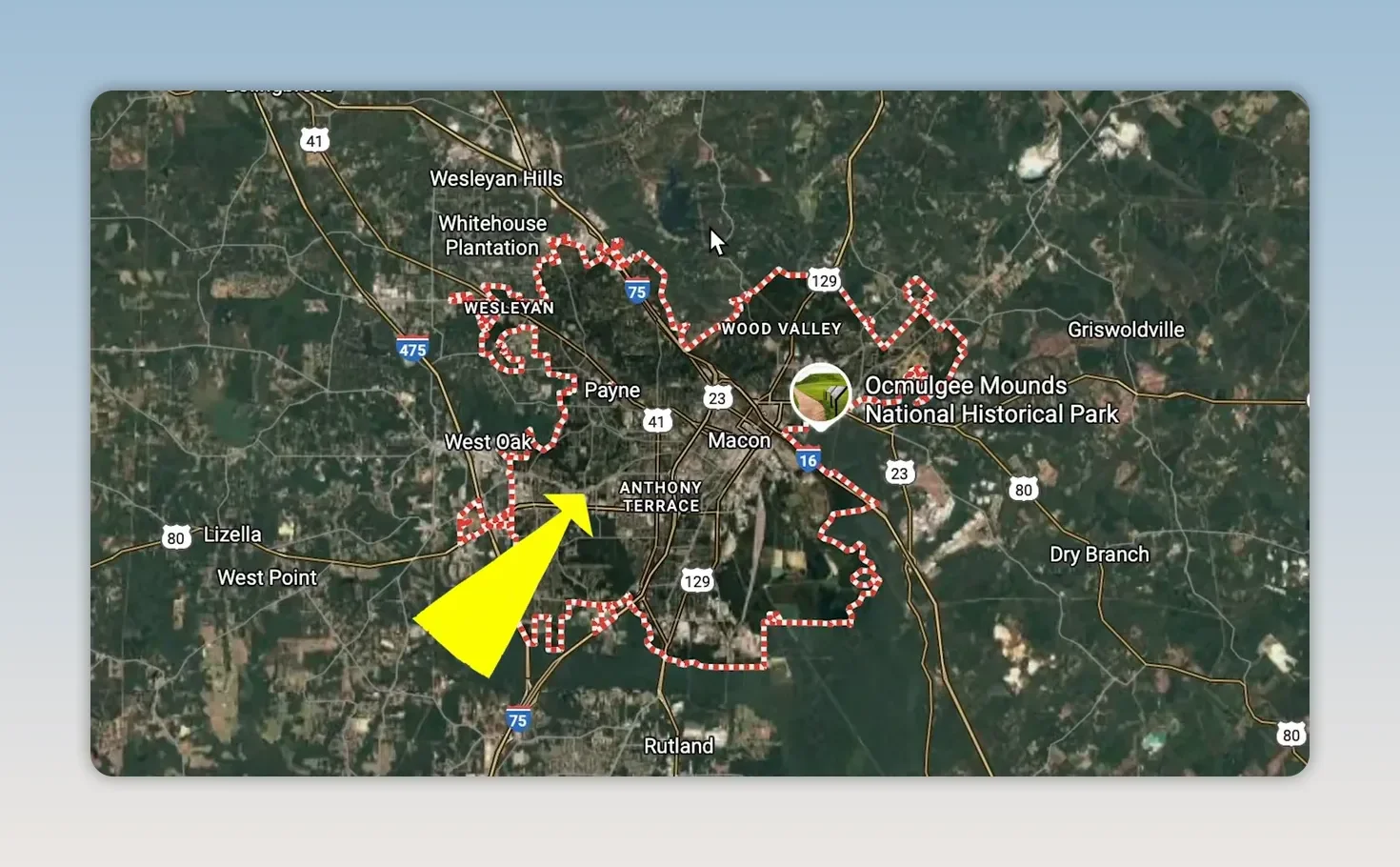
Middle Georgia covers multiple communities, so day-to-day mobility extends well beyond Macon proper.
The Bottom Line: Macon Is Not Perfect, and That Is the Point
No city is perfect. Macon has neighborhoods that demand careful research, uneven school options, lower local wages in some fields, older homes that need money put into them, brutal summer humidity, and limited transit.
But if you can handle those realities, you may be exactly the type of person who loves living here. The affordability can be excellent, the right neighborhoods can be a strong fit, and the weather outside that summer heat pocket is hard to beat.
The move needs to be personal. Your budget, job situation, school priorities, commute, desired home condition, and lifestyle all matter. Get clear on those first, then choose the Middle Georgia neighborhood that fits instead of assuming the entire region works the same way.